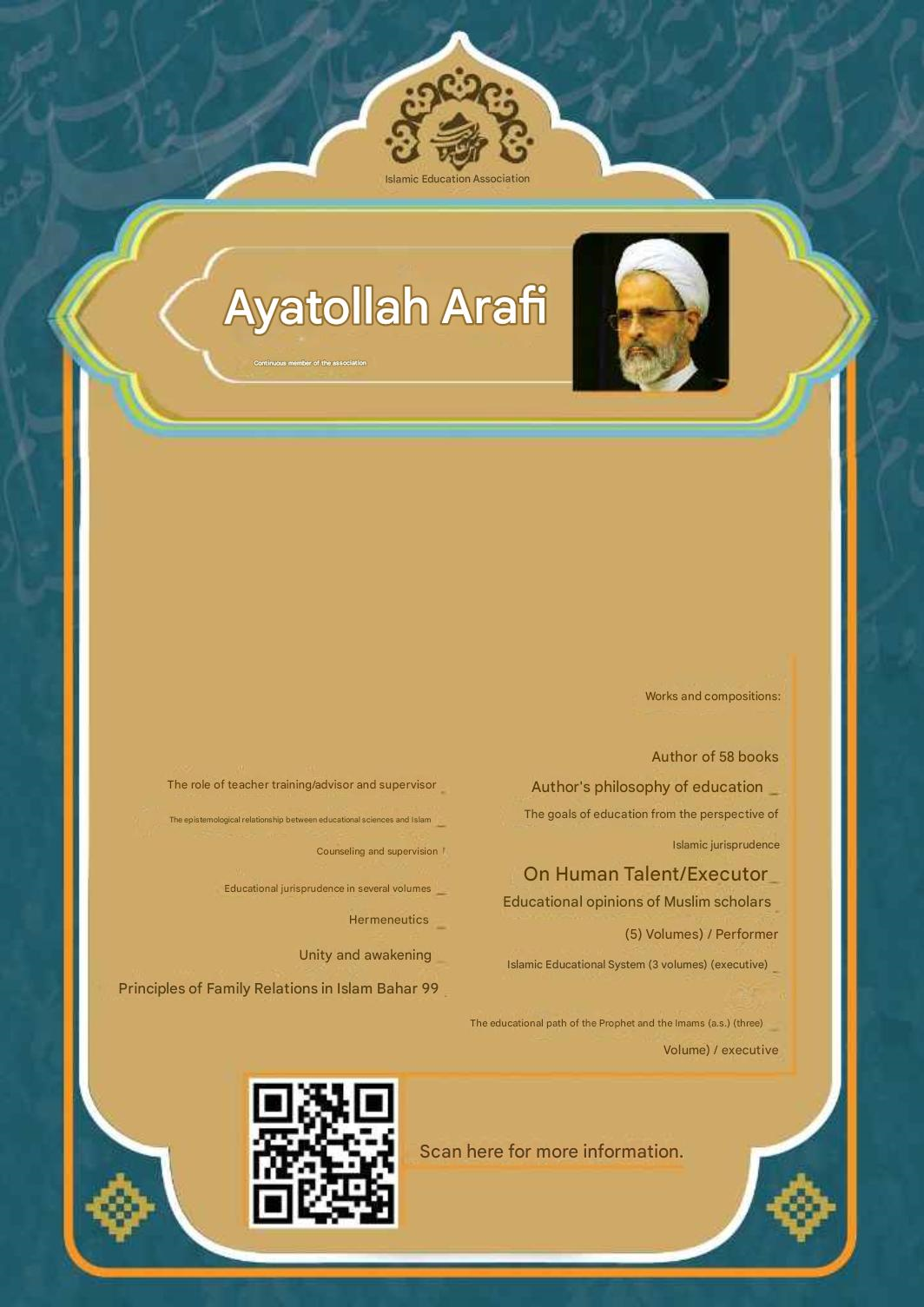
A) Personal details
Birth:
Ayatollah Arefi was born in 1338 AH in Meybod, Yazd Province, in a house that had long been a refuge for devout believers and the oppressed under the Pahlavi regime. His father, Ayatollah Mohammad-Ibrahim Arefi (RA), was a devout, brave, and people-oriented scholar who played a central role in reviving Islamic values and Islamic rituals in the region and stood firmly against the cultural aggression and injustice of the regime. Arefi, a close friend of Imam Khomeini (RA), helped awaken the people of Meybod and Yazd years before the revolution by organizing Friday prayers and calling people to participate, thereby shaping a devout, knowledgeable, and revolutionary generation for the region and the country.
His mother, Ayatollah Ali Reza Arefi’s mother (i.e., Ayatollah Alireza Arefi’s mother), was a devout and virtuous woman who was the daughter of Ayatollah Sheikh Kazem Malek Afzali Ardakani (RA), and together with her father worked to upbringing the children and advance Islamic aims.
Education:
After learning to read the Qur’an, literature, and basic Islamic rulings in childhood under his father and other teachers, Ayatollah Arefi migrated to Qom in 1349 AH and pursued classical studies, beginning seminary studies in 1350 AH. With natural zeal and ability, and through remarkable diligence, he quickly completed the introductory and intermediate levels of seminary studies, so that by 1356 AH he was attending the advanced course (Kharij). Ayatollah Arefi is among those religious scholars who absorbed the thought of many teachers across disciplines and benefited from the guidance of each of them.
During his studies, he studied in the Kharij courses under senior scholars such as Ayatollah al-‘Uzma Sheikh Morteza Haeri (RA), Ayatollah al-‘Uzma Fadl al-Lankarani (RA), Ayatollah al-‘Uzma Wahid Khurasani (Damat Barakatuh), and Ayatollah al-‘Uzma Javad Tabrizi (RA). He participated in Quranic exegesis under Ayatollah Mirza Ali Makkiyni (RA) and in the assembly of Allama Hassan zade Amoli (may God protect him). He studied philosophy and practical books in philosophy and economics (the works of martyr Sayyid Muhammad Sadr) under Ayatollah Sayyid Kazem Ha’eri (may God protect him). He also learned some of the Four-Volume Commentary (Asfar al-Arba‘a) and the works of Sharh al-Hikma with Ayatollah Ja’fari Amoli (Damat Barakatuh) and learned parts of Asfar under Martyr Motahari (RA). He benefited from Allameh Habibi Misbah Yazdi (RA) in philosophical discussions, and throughout these years he did not neglect moral instruction, ethics lectures, and gatherings with his ethics teachers; he consistently aligned study with self-discipline, reflection, and adherence to the example of the great predecessors, especially his venerable father.
Scientific movement:
Arefi’s mentorship under these eminent figures shaped his thinking and ethics so that, as the hiO-halves of knowledge and piety rose to meet him, he could engage society’s new frontiers with a strong grasp of social and intellectual issues. His studies included learning Arabic and English, and extensive study across mathematics, Western philosophy, humanities, and social sciences. His participation in the Education and Humanities Research Office of Hawzah and University (Hawzah-Universities Research Institute) helped him become a model for how to engage, critique, and dialogue with modern schools of thought and to connect with a new generation of students in both the Hawzah and the university world. Over the past four decades, he has taught at various universities, both domestic and international.
During his studies, Ayatollah Arefi used his holidays to engage in Tafsir al-Mizan, Nahj al-Balagha, and other scholarly works, enriching his intellectual and ethical framework through the illumination of revelation and the guidance of the Prophet and the Imams (peace be upon them). His cultural and social movement ultimately led him to teach in a way that integrates library-based and field research in education and upbringing. He innovated and aligned the classical discussions of old books with contemporary issues, teaching “Fiqh al-Tarbiyah” (Legal-educational jurisprudence) and laying foundations for new jurisprudential openings in the fields of educational sciences and the philosophy of education. This culminated in the Global Award for Islamic Humanities in Education (the Innovation and Theory-building award) being conferred on him. Throughout this period, he continued to teach the four books of philosophy (Asfar al-Arba‘a) and the Fiqh and Usul (jurisprudence and principles), continued mentoring many students in jurisprudence, principles, and philosophy, and remained a central figure in ethical study and moral guidance in Hawzah.
Ayatollah Arefi, due to his extensive studies in various sciences and his close observation of scholarly centers around the world, is among the few religious scholars who, during the era of the transition of the Hawzah to a new phase in the fourth decade of the Islamic Revolution, have monitored and analyzed the emergence of new intellectual, political, and social discourses and phenomena, and identified opportunities and threats. His scientific and executive responsibilities reflect his religious, popular, scholarly, and ethical stature; while being a member of the Society of Teachers of Qom Hawzah, he maintains close ties with scholars and the Hawzah community, and as the head of Hawzah centers across the country, he collaborates with intellectuals and elites.
Political and social outlook:
Ayatollah Arefi, who rose from a family of jihad and scholarship and observed his father’s struggle and the presence of activists in the home from childhood, experienced association and solidarity with opponents during the upheavals and was imprisoned at age 16. After the revolution, he did not rest in defending the values attained. During the years of the Holy Defense (the Iran-Iraq War), he repeatedly visited the frontlines and encouraged the fighters for Islam. With the spirit of leadership and guardianship, he has stood alongside the people as a defender of the blood of martyrs and the values gained, and, guided by duty, he never shirked the responsibilities placed on him by Islam and the Revolution.
His political and social concerns include upholding the guardianship of the jurist (Velayat-e Faqih), safeguarding the values gained from the blood of the martyrs, respecting religious democracy and the rule of law and people’s votes, addressing social ills such as unemployment and inflation, and upholding Islamic ethics in political life.
B) Executive responsibilities
Organization/Institution / Type of Activity / Position
Imamate and Friday Prayer Leader, City of Qom
Director of Hawzah Centers across Iran
Member, Guardian Council
Member, Assembly of Experts
World Assembly of Al-Mustafa / Board of Trustees / President (formerly)
Supreme Council for the Cultural Revolution / Real Member
Public Culture Council of the Ministry of Culture and Islamic Guidance / Research / Member
World Assembly of Al-Mustafa / Scientific–Administrative / President (formerly)
Hawzah-University Research Institute of Qom / Research–Educational–Administrative / President (formerly)
Hawzah-University Research Institute of Qom / Research / Head of the Department of Educational Sciences / Vice-Research (formerly)
International Center for Islamic Sciences / Scientific–Administrative / President (formerly)
Cultural-Social Council of the Ministry of Science, Research and Technology / Research–Administrative / Member (formerly)
Imam Khomeini Educational-Research Institute (Qom) / Research / Head of the Education Sciences Department (formerly)
World Center for Islamic Sciences and School Network / Scientific–Administrative / Member of the Board of Trustees (formerly)
Center for Hawzah Services / Board Member
Hawza Commission, Supreme Cultural Revolution / Member
Friday Prayer Leader, Meybod County (Yazd Province)
Hawzah for Brothers and Sisters of Meybod / Supervisor
Payame Noor University, Faculty of Theology, Applied-Science University, Quranic Sciences, Meybod Genetics Research Center / Board of Trustees Member
International Huda Institute / Executive / Board Member (formerly)
Qom Hawzah / Scientific–Administrative / Deputy Research
National Congress of Religious Researchers / Research / Member (formerly)
Hawza and University Journal / Executive / Editor-in-Chief
Office of Propagation, Qom Hawzah / Executive / Board Member (formerly)
Society of the Teachers of Qom Hawzah / Member
Supreme Council for Planning, Ministry of Science / Member
Education and Training Vision Document / Supervisor
Supreme Council of Hawzah Centers / Member
Ishraq and Erfan Institute / Founder / Chairman of the Board
C) Research experience
Project title / Role in the project
Philosophy of Education / Author
Objectives of Education from an Islamic Perspective / Principal Investigator
Inborn human potential (talent) / Principal Investigator
Educational views of Muslim scholars (5 volumes) / Principal Investigator
The Islamic Education System (3 volumes) / Principal Investigator
Educational biography of the Prophet and Imams (3 volumes) / Principal Investigator
The role of teacher education / Advisor and Supervisor
The intellectual relationship between Educational Sciences and Islam / Consultant and Supervisor
A collection of articles / Principal Investigator, Advisor, and Mentor
D) Educational experience
Course titles / Institution
Fiqh and Usul in the intermediate level, Hawzah of Qom
Islamic Philosophy, works: Bidaya, Nahayah, Asfar, and Logic / Hawzah of Qom
Extraphysical Fiqh: Qadi and testimonies and delimitations / Hawzah of Qom
External Usul al-Fiqh / Hawzah of Qom
Fiqh al-Tarbiyah / Hawzah of Qom
Islamic Mysticism (Irfan) — Tamhid al-Qawaid / World Center for Islamic Sciences
Philosophy of Education and Education in Qur’an and Hadith / Tarbiat Modares University, Tehran
Islamic Education / Imam Khomeini Educational-Research Institute (Qom) and other centers for propagation and interpretation
Philosophy of Ethics / Imam Khomeini Institute and other Hawzah centers
Philosophy / University of Qom (Higher Judicial School)
Arabic Dars (Religious Studies) / Allameh Tabataba’i University
Hawzah-based curriculum and related courses / University of Qom
Additional courses across various educational and theological programs
E) Theses supervised (titles, degree, year)
The extent of alignment of content and goals of religious instruction books for the intermediate level / Master’s
Motivation in ethics from the Qur’anic perspective / Master’s
Pedagogical methods — admonition and exhortation in the Qur’an / Master’s
Comparative study of Fitrah from Motahari’s viewpoint and aptitude from the perspective of Eskhler (the author cited) and its implications / Master’s
The relationship between revelational teachings and the student of education from an epistemological standpoint / PhD
The relation of fiqh and education / Master’s
The history of the evolution of ijtihad periods / Master’s
The place of reason and epistemology in Allameh Tabataba’i’s thought and its implications for rational education / Master’s
Etiologies and methods of education in the conduct of the Imams (peace be upon them) / Master’s
Educational views of Imam Khomeini / Master’s
Foundational theological discussions of religious governance / PhD (Level 4 Hawza)
Family in Islam / Master’s
Childrearing in the Qur’an / Master’s
Materialism: roots and causes from an Islamic viewpoint / Master’s
Islam and democracy / Master’s
Moral education in the conduct of the Imams / Master’s
Harmful methods in Islamic upbringing / Master’s
And many other theses
F) Books
Sculpture and Painting / Winter 1390
Unity of Hawzah and University / Autumn 1392
Fiqh Tarbiyah Vol 1 (Principles and Assumptions) / Spring 1395
Fiqh Tarbiyah Vol 2 (Learning of Knowledge and Religion) / Autumn 1396
Philosophical and Jurisprudential analysis of philosophy and pedagogy / Spring 1391
Legal Principles (Qawa’id) / Spring 1393
Heresiology / Summer 1395
Rulings on child education / Spring 1395
Parenting with a jurisprudential approach / Summer 1395
An introduction to educational interpretation / Spring 1397
The Subconscious in the Qur’an / Summer 1393
Fiqh Tarbiyah Vol 1 (New Edition) / Spring 1395
Fiqh Tarbiyah Vol 4: Teaching and Learning of Sciences and Knowledge (Rational) / Summer 1395
Fiqh Tarbiyah Vol 5: Teaching and Learning of Spiritual and Visual Knowledge / Spring 1395
Fiqh Tarbiyah Vol 7: Common Etiquettes of Teaching and Learning / Spring 1395
Makasib Muharama Vol 1 (Impurities in Objects) / Fall 1395
Makasib Muharama Vol 2 (Impurities in Substances) / Summer 1395
Makasib Muharama Vol 5 (Prohibitions of Knowledge) / Winter 1395
Makasib Muharama Vol 6 (Prohibitions of Arts) / Summer 1395
Methods of Education / Winter 1395
Hermeneutics / Spring 1395
An Introduction to Civilizational Education / Spring 1395
Hawzah: Its Nature, Past, Present and Future / Spring 1395
Fiqh Tarbiyah Vol 2 (Third Edition) / Autumn 1396
Fiqh Tarbiyah Vol 24 (Religious Education) / Spring 1396
Makasib Muharama Vol 3 (Trade with Prohibited Goods) / Winter 1396
Makasib Muharama Vol 4 (Prohibitions of Sciences 1) / Winter 1396
Qalamroudin and the Realm of Shari’ah / Spring 1396
Jurisprudential Analysis of Slander and Insults / Summer 1396
Sun of Ashura / Autumn 1396
Fiqh Tarbiyah Vol 26 (Responsibilities of Educational Institutions: Governance) / Summer 1399
Fiqh Tarbiyah Vol 7.2 (Etiquette of Teaching and Learning) / Fall 1399
Ijtihad and Imitation Vol 2 (Ways of Obtaining Rulings 1) / Fall 1399
Fiqh Amr bi Ma’ruf and Nahi an al-Munkar (Editing) / 1399
Fiqh Tarbiyah Vol 30 (Rules) / Editing / 1399
More titles on Hawzah and Civilizational discourse and Islamic Revolution literature, Da’wah, Demonology, etc. (various years)
G) Names and details of scientific awards
Won the Global Award for Innovation and Theory-building in Islamic Humanities in the field of Islamic Education (second cycle)
First place for the Best Hawza Book in 1377 for the book “Views of Muslim Scientists on Education and Its Foundations” (Volume 1)
Selected for the Third International Congress of Religious Researchers in 1380 for the book “Education of Children: The Educational Path of the Prophet (PBUH) and the Ahl al-Bayt”
First Prize in the 21st Iran Book of the Year selections in 1382 for the book “Views of Muslim Scholars on Education and Its Foundations” (Volume 3)
Best Research Award (Fiqh Tarbiyah)
Best Book Award in Hawza Book Year 1394 for the book “Child Rearing with a Jurisprudential Approach”
If you’d like, I can format this as a clean Word document or adjust the wording for a CV-style presentation.


